

The Holy Trinity Explained: One God in Three Persons
Few teachings in Christianity are as central, profound, and sometimes misunderstood as the Holy Trinity.

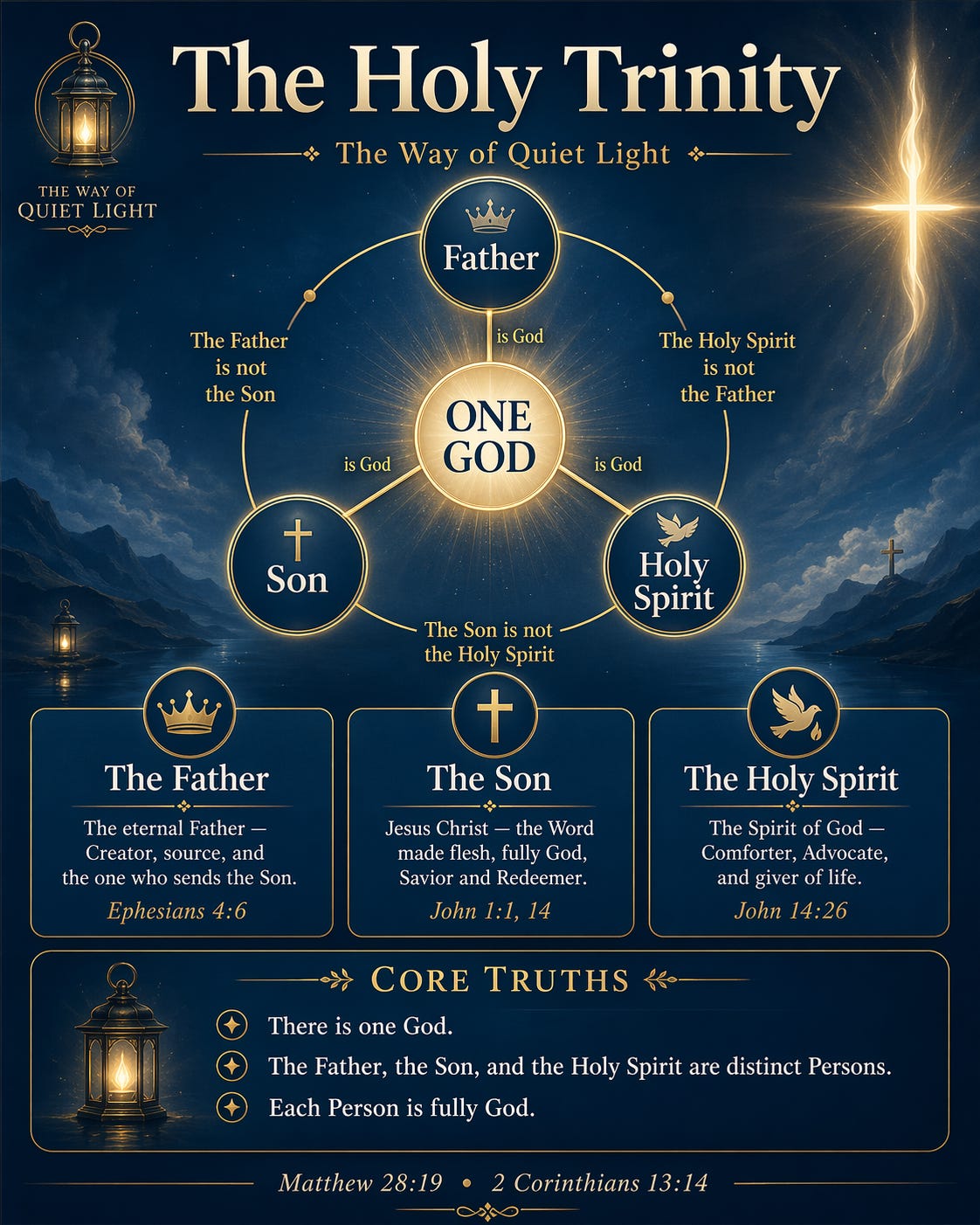
Few teachings in Christianity are as central, profound, and sometimes misunderstood as the Holy Trinity. Many have heard the phrase Father, Son, and Holy Spirit, yet not everyone fully understands what it means or why it matters.
The Trinity is not an abstract theological puzzle meant only for scholars. It is one of the most important truths of the Christian faith because it helps us understand who God is, how God has revealed Himself, and how we relate to Him.
To understand Christianity properly, we must understand the Trinity.
What Is the Holy Trinity?
The doctrine of the Trinity teaches that:
There is one God
God exists eternally as three distinct Persons
These Persons are:
The Father
The Son (Jesus Christ)
The Holy Spirit
These three are not three gods. Christianity is not polytheistic. There is only one true God.
Scripture is clear:
“Hear, O Israel: The Lord our God, the Lord is one.”
— Deuteronomy 6:4
Yet Scripture also reveals the Father as God, the Son as God, and the Holy Spirit as God.
This is why Christians confess One God in Three Persons.
The Father Is God
This truth is widely accepted and clearly taught throughout Scripture.
“Grace to you and peace from God our Father and the Lord Jesus Christ.”
— Romans 1:7
The Father is the source of creation, the one who sends the Son, and the one who loves the world.
“For God so loved the world that he gave his only begotten Son...”
— John 3:16
The Son Is God
Jesus Christ is not merely a prophet, teacher, or created being. Christianity teaches that Jesus is fully God and fully man.
John opens his Gospel with these powerful words:
“In the beginning was the Word, and the Word was with God, and the Word was God.”
— John 1:1
And then:
“And the Word was made flesh, and dwelt among us...”
— John 1:14
Jesus accepted worship, forgave sins, calmed storms, raised the dead, and declared divine authority.
Thomas, after seeing the risen Christ, said:
“My Lord and my God.”
— John 20:28
Jesus did not correct him.
The Holy Spirit Is God
The Holy Spirit is not merely an energy or force. The Holy Spirit is divine, personal, and active.
In Acts, lying to the Holy Spirit is equated with lying to God:
“You have not lied unto men, but unto God.”
— Acts 5:3–4
The Holy Spirit teaches, comforts, convicts, guides, and empowers believers.
Jesus said:
“But the Comforter, which is the Holy Ghost... he shall teach you all things.”
— John 14:26
Distinct Persons, Perfect Unity
The Father is not the Son.
The Son is not the Holy Spirit.
The Holy Spirit is not the Father.
They are distinct Persons, yet perfectly united in essence, will, and glory.
We see this clearly at the baptism of Jesus:
“And Jesus, when he was baptized, went up straightway out of the water... and he saw the Spirit of God descending like a dove... And lo a voice from heaven, saying, This is my beloved Son...”
— Matthew 3:16–17
In one moment:
The Son is baptized
The Spirit descends
The Father speaks
All three are present.
Why the Trinity Matters
Some ask, “Why does this doctrine matter in everyday life?”
Because the Trinity reveals the very nature of God.
1. God Is Relational
Before creation existed, love already existed within God Himself—Father, Son, and Spirit in eternal fellowship.
“God is love.”
— 1 John 4:8
Love did not begin when humans were created. Love has always existed within the Trinity.
2. Salvation Is Trinitarian
Our salvation involves all three Persons:
The Father sends the Son
The Son dies and rises again
The Holy Spirit applies grace to believers
“Elect according to the foreknowledge of God the Father, through sanctification of the Spirit, unto obedience and sprinkling of the blood of Jesus Christ...”
— 1 Peter 1:2
3. Prayer Makes Sense Through the Trinity
Christians pray to the Father, through the Son, by the Holy Spirit.
“For through him we both have access by one Spirit unto the Father.”
— Ephesians 2:18
Common Misunderstandings
“Christians Worship Three Gods”
False. Christianity teaches one God.
“The Trinity Means Three Parts of God”
False. Each Person is fully God, not one-third of God.
“The Trinity Is Invented”
False. The word Trinity developed later as a summary term, but the teaching comes directly from Scripture.
Jesus commanded baptism:
“In the name of the Father, and of the Son, and of the Holy Ghost.”
— Matthew 28:19
Notice name is singular, yet three Persons are named.
Can We Fully Understand the Trinity?
Not completely.
The Trinity is understandable in part, but God is greater than the human mind can fully contain.
If God were small enough to be fully explained, He would not be God.
Scripture gives us enough truth to know Him, worship Him, and trust Him.
Why This Is Foundational to Christianity
If Jesus is not truly God, salvation collapses.
If the Holy Spirit is not truly God, divine transformation collapses.
If God is not Father, Son, and Spirit, the Gospel story itself changes.
The Trinity is not an optional side doctrine. It sits at the heart of Christian belief.
A Simple Summary
There is one God.
The Father is God.
The Son is God.
The Holy Spirit is God.
The Father is not the Son.
The Son is not the Spirit.
The Spirit is not the Father.
One God. Three Persons. Eternal Glory.
Final Reflection
The Trinity reminds us that God is deeper than slogans, richer than shallow religion, and more glorious than human categories.
He is the Father who loves.
He is the Son who saves.
He is the Spirit who dwells with His people.
To know the Trinity is not merely to know doctrine.
It is to know the God of Christianity.
“The grace of the Lord Jesus Christ, and the love of God, and the communion of the Holy Ghost, be with you all.”
— 2 Corinthians 13:14
A Note from Joshua Eaton, The Lantern’s Keeper
The language used throughout this article has been intentionally presented in a simpler, clearer, and more accessible form so that the teaching may be understood by as many people as possible.
Some theological subjects, especially ones as profound as the Holy Trinity, are often explained using highly technical or academic language that can feel difficult, distant, or overwhelming to the average reader. My desire here was not to diminish the depth of the doctrine, but to make it more serviceable to everyday people seeking truth.
Faith should not be hidden behind unnecessary complexity. The truths of God should be able to reach ordinary hearts, ordinary homes, and ordinary lives.
For that reason, this lesson was written in plain and understandable English so that more people may read it, reflect on it, and grow in their understanding of the Christian faith.
— Joshua Eaton
The Lantern’s Keeper